
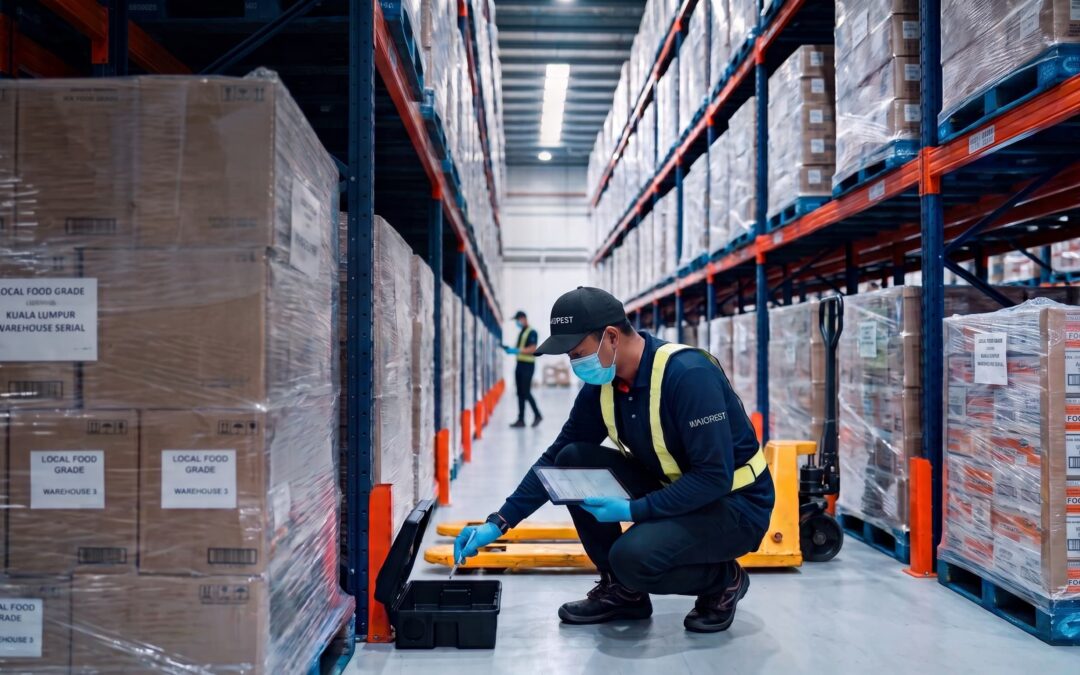
Warehouse pest control works best as integrated pest management (IPM) — a documented programme of exclusion, sanitation, monitoring and targeted treatment that keeps a facility pest-free and audit-ready. It matters because a warehouse is uniquely exposed: goods arrive on pallets and in containers from dozens of sources, dock doors sit open to the outside for hours a day, and high racking makes large areas hard to inspect. This guide explains what a proper warehouse IPM programme involves and how it supports HACCP, FSSC 22000 and BRCGS audits.
What is integrated pest management (IPM) for a warehouse?
Integrated pest management is a prevention-first approach that controls pests by removing the conditions they need — entry points, food, harbourage — and uses chemical treatment only when monitoring shows it is necessary. For a warehouse, IPM rests on four pillars:
- Exclusion — sealing the building so pests cannot get in (dock seals, strip curtains, door sweeps, proofed service penetrations).
- Sanitation — housekeeping standards that deny pests food and shelter (spill clean-up, waste management, removing damaged stock and empty pallets).
- Monitoring — a fixed network of rodent stations, insect light traps and pheromone monitors, inspected on a schedule and trended over time.
- Responsible treatment — targeted, approved products applied only where monitoring data justifies it, never as a blanket spray over stored goods.
A reactive, "call someone when we see a rat" approach fails on all four counts — and in Malaysia's climate, where pests breed year-round, it lets infestations establish before anyone reacts.
Why are warehouses so exposed to pests?
Warehouses combine several risk factors that a typical office or shop does not:
| Entry route | Pests it brings in | What's at risk |
| Inbound pallets, cartons, containers | Rodents, cockroaches, ants, stored product insects | Contaminated stock, spread through the racking |
| Loading docks and dock doors | Rodents, birds, flies | Droppings, chewed packaging, audit findings |
| Service penetrations, gaps, damaged walls | Rodents, insects | Wiring damage (fire risk), nesting |
| Roof space and high rafters | Pigeons, mynas, bats | Droppings on stock, slip hazards, corrosion |
| Landscaping and external waste | Rodents, flies, mosquitoes | Pressure on the perimeter |
Add a large floor area with low foot traffic in some zones, and pests can go unnoticed for weeks. This is why monitoring and inbound inspection matter more in a warehouse than almost anywhere else.
Which pests matter most in Malaysian warehouses?
- Rodents (rats and mice) — the top concern. They gnaw through packaging and pallet wrap, chew electrical wiring (a genuine fire risk), and contaminate stock with droppings, urine and hair.
- Stored product insects — weevils, flour beetles, warehouse moths and grain borers in food, ingredient, animal-feed and agricultural warehouses. They arrive inside incoming product and multiply in spillage and old stock.
- Birds — pigeons and mynas roosting on racking, rafters and external ledges. Droppings contaminate stock below, create slip hazards and fail hygiene audits.
- Cockroaches and ants — around break rooms, drains, and damaged or leaking goods.
- Flies — concentrated near dock doors, waste areas and any organic spillage.
What does a warehouse IPM programme actually involve?
A structured programme runs in this order:
- Site survey and risk mapping — an entomologist-led walk of the whole facility to identify entry points, harbourage and high-risk zones, mapped on a site plan.
- Exclusion works — recommendations (and coordination) for dock seals, strip curtains, door sweeps, mesh screens and proofing of gaps and penetrations.
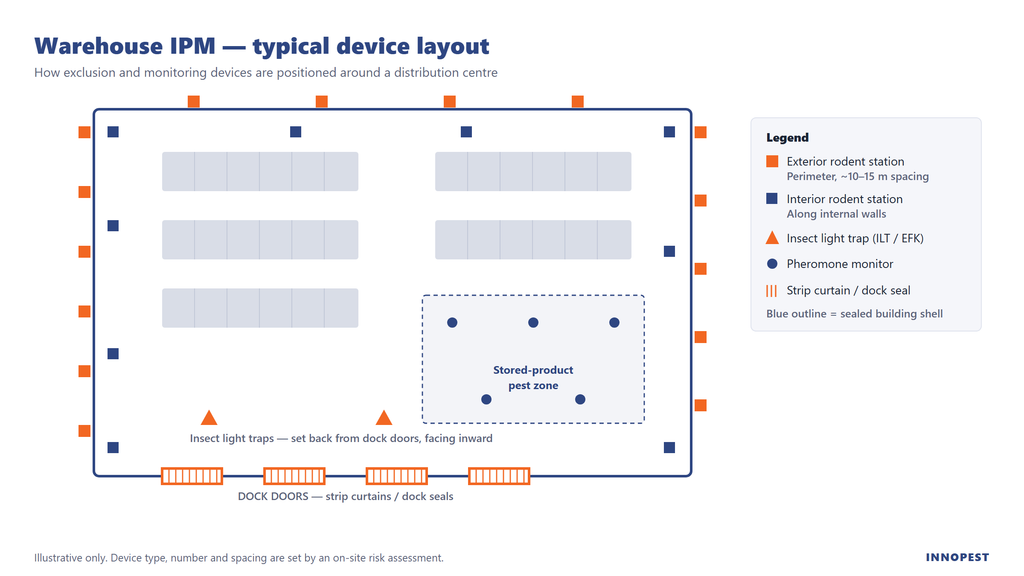
- Monitoring network — tamper-resistant rodent stations around the perimeter and internally, insect light traps positioned away from doors so they don't draw pests in, and pheromone traps where stored product insects are a risk. Every device is numbered and plotted.
- Inbound inspection protocol — a simple check routine for receiving staff: inspect pallets and cartons for gnaw marks, droppings, live insects and webbing before goods enter the racking.
- Sanitation standards — agreed housekeeping practices, spill response and waste management.
- Scheduled service visits — typically monthly, more frequent for food-grade or high-risk sites. Each visit records device activity, findings and actions.
- Trend reporting and corrective actions — catch data is trended over time so a rising problem is visible early, with documented corrective actions closed out.
- Targeted treatment — applied only where monitoring justifies it, using approved products and methods appropriate to a storage environment.
How does warehouse pest control support HACCP, FSSC 22000 and BRCGS audits?
For any warehouse certified to a food-safety or quality standard, pest management is an audited requirement — not an optional service. An auditor will typically ask to see:
- A licensed Pest Control Operator (in Malaysia, licensed by the Ministry of Agriculture) with current contractor certification.
- A documented pest management programme with a defined scope and frequency.
- A site plan showing every monitoring device by number and location.
- Service records for every visit, with findings and actions.
- Trend analysis of pest activity over time.
- A pest sighting log for staff-reported activity, with corrective actions closed out.
- Safety data and approval status for any products used.
A single live rodent, bird droppings on stock, or a gap in the records can become a non-conformance that holds up certification or a customer approval. Innopest builds its warehouse programmes to be audit-ready from day one — the documentation is designed to be handed straight to an auditor.
Frequently asked questions
How often should a warehouse be serviced?
Most warehouses are on a monthly schedule. Food-grade, ingredient and high-risk sites are often serviced fortnightly, and the frequency should be set by a documented risk assessment rather than a fixed default.
Are the treatments safe around stored food and packaging?
Yes, when done properly. IPM relies on physical exclusion and contained monitoring devices rather than spraying near goods. Any treatment uses approved products applied by trained technicians, with safety data available for your records.
Can pest control really affect our audit result?
Yes. Pest management is a scored element in HACCP, FSSC 22000, BRCGS Storage & Distribution and most customer audits. Live pest evidence or incomplete records can result in a non-conformance.
Do you cover warehouses outside the Klang Valley?
Innopest runs regional offices in Penang (HQ), Puchong (Selangor & KL) and Johor Bahru, covering logistics and warehousing facilities across northern, central and southern Peninsular Malaysia.
Protect your facility and your audit
If you manage a warehouse or distribution centre in Malaysia, an entomologist-led IPM programme is the difference between reacting to pests and being able to prove control. Book a site inspection with the Innopest technical team and we'll survey your facility, map the risks and build a programme your auditors can rely on.
Written by the Innopest technical team. Innopest is a licensed Pest Control Operator (Ministry of Agriculture Malaysia), ISO 9001, 14001 and 45001 certified, and has served Malaysia's manufacturing, F&B and logistics sectors since 2012.
Related reading: Factory pest control · Commercial pest control · Pest control in Selangor & KL
Recent Comments